

The Aerosmith legend is reportedly turning a deeply personal piece of his past into “Janie’s Haven,” a place built not for luxury, but for healing, recovery and second chances.
For more than five decades, Steven Tyler has been associated with everything that comes with rock ’n’ roll mythology: sold-out arenas, screaming crowds, private jets, extravagant clothes and the unmistakable sound of Aerosmith.
But this time, the figure attached to his name is not the price of a mansion, a new tour or another piece of rock-star excess.
It is $2.5 million — devoted to a second chance for people who desperately need one.
According to the story behind the project, Tyler has repurchased a modest home connected to memories from his younger years and plans to transform the property into “Janie’s Haven,” a recovery center for women and children facing homelessness, addiction, abuse and long-term trauma.
The contrast could hardly be greater.
A man who spent much of his life performing beneath stadium lights is now focusing attention on something far quieter: creating a place where people can begin rebuilding their lives.

Steven Tyler has spent decades commanding some of the world’s biggest stages, but his philanthropic work has increasingly become another important part of his public legacy.
FROM ROCK ’N’ ROLL EXCESS TO SECOND CHANCES
Tyler’s connection to addiction and recovery is deeply personal.
The Aerosmith frontman has spoken publicly over the years about his own struggles with substance abuse and the difficult journey that followed. Those experiences have given his charitable work a significance that reaches beyond simply writing a check.
At the center of this new narrative is one idea:
A difficult past does not have to determine someone’s future.
The proposed Janie’s Haven would be designed as far more than temporary accommodation. The vision includes safe housing, psychological counseling, addiction-recovery support, life-skills training and programs intended to help women and children move toward independent lives.
For Tyler, the mission also echoes work he has already pursued for years through Janie’s Fund, the initiative he created with Youth Villages to support girls who have suffered abuse and neglect. The organization says Tyler was inspired in part by experiences during his own recovery and by questions raised through Aerosmith’s 1989 song Janie’s Got a Gun.
WHY THE NAME “JANIE” MATTERS
To Aerosmith fans, Janie is immediately recognizable.
Janie’s Got a Gun told the dark story of a young girl responding to abuse. Beneath its enormous commercial success was a subject rarely addressed so directly in mainstream rock music at the time.
Years later, that fictional character became connected to something tangible.
Tyler founded Janie’s Fund in 2015, working with Youth Villages to bring attention and financial support to programs helping girls affected by abuse and neglect.
That mission eventually led to the creation of Janie’s House residential facilities.
In 2017, the first Janie’s House opened at Youth Villages’ Inner Harbour Campus outside Atlanta. A second facility opened near Memphis in 2019. The Bartlett, Tennessee location was designed to provide residential accommodation, medical care and therapeutic support for vulnerable girls.
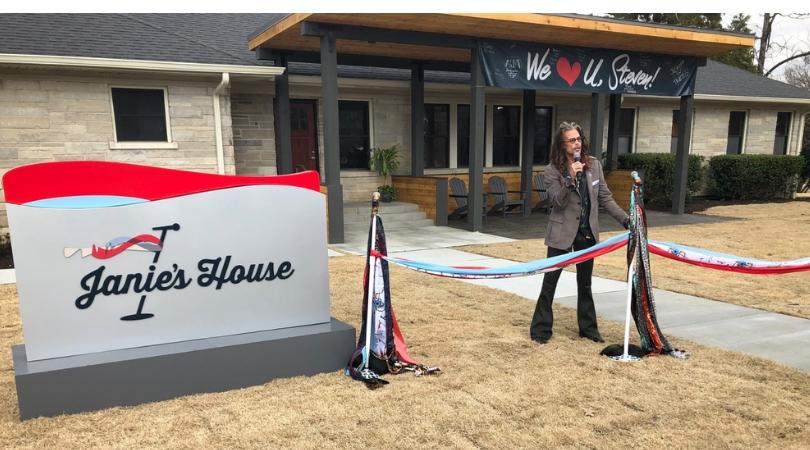
Steven Tyler at events connected with Janie’s Fund and Janie’s House, the charitable mission inspired by his desire to support survivors of abuse and neglect.
MORE THAN A PLACE TO SLEEP
That history is what gives the idea of Janie’s Haven its emotional weight.
A recovery center cannot erase what happened to someone. It cannot instantly repair years of trauma, addiction or instability.
But it can provide something equally important: a safe place from which rebuilding can begin.
The imagined $2.5 million project would combine shelter with counseling, structured recovery support and practical assistance — recognizing that people escaping homelessness, addiction or abusive environments often need far more than a roof over their heads.
They need time.
They need stability.
And they need people willing to believe that their lives can still become something different.
That philosophy already resembles the work behind Janie’s Fund. The organization says its programs emphasize trauma-informed approaches, therapy and longer-term support for young people who have experienced abuse and neglect.
A DIFFERENT KIND OF LEGACY
Steven Tyler’s musical legacy is already secure.
As the voice behind generations of Aerosmith songs, he has experienced the kind of career few musicians ever reach. The records, tours, awards and memories created in packed arenas will remain part of rock history.
But legacy changes as people grow older.
Eventually, the question becomes less about what someone achieved and more about what they chose to do with everything those achievements gave them.
For Tyler, the answer increasingly appears connected to people whose struggles rarely receive applause or spotlights.
He cannot rewrite the hardest chapters of his own life.
He cannot erase another person’s trauma.
But he can help create the conditions in which somebody gets another opportunity to stand up again.
And perhaps that is why the image behind this story feels so powerful.
Not Steven Tyler standing beneath a wall of lights with a microphone wrapped in scarves.
But Steven Tyler standing outside a modest house — one transformed into a place where women and children can walk through the door carrying the weight of their past and, eventually, leave believing in their future.
From sold-out stadiums to a $2.5 million home centered on healing, dignity and new beginnings, it would represent a very different kind of encore.
And perhaps one of the most meaningful of his life.


