

For decades, Sylvester Stallone made a living convincing audiences that he could take almost anything.
Rocky Balboa absorbed punches and kept moving forward. John Rambo survived wars, prisons and enemies who underestimated him. Later, Barney Ross became the veteran leader of a team built around men who seemed almost impossible to kill.
The body became part of the mythology.
The shoulders. The arms. The training. The scars. The expression that seemed to say pain was simply another obstacle to push through.
But the image audiences saw on screen concealed a much more complicated life.
Behind one of Hollywood’s toughest-looking stars was a man shaped by rejection, an unsettled childhood, career failures, family strain and losses that no amount of physical conditioning could solve.
STRENGTH WAS NEVER SOMETHING HE WAS BORN WITH
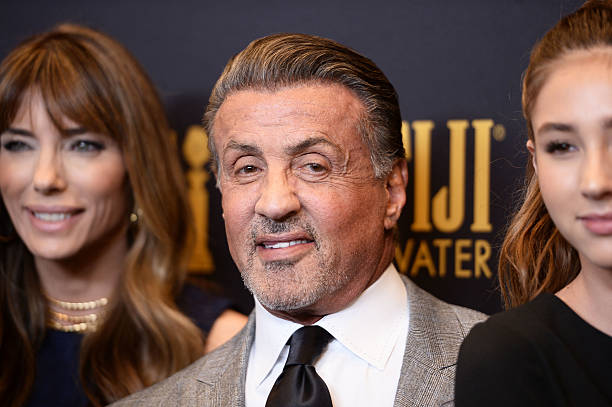
Even Stallone’s distinctive appearance came from difficulty.
Complications during his birth damaged nerves on the left side of his face, leaving part of it partially paralyzed and contributing to the facial droop and speech pattern that would later become instantly recognizable.
In another career, those characteristics might have remained obstacles.
In Stallone’s case, they eventually became part of his identity.
But childhood brought challenges that went far beyond appearance.
Stallone has spoken increasingly openly about growing up in a troubled family environment. Ahead of the publication of his 2026 memoir The Steps, he described physical punishment, emotional instability and being expelled from numerous schools before being sent as a teenager to a residential school for troubled youths.
He remembered that period not as an inspirational training ground, but as something much darker — an environment filled with angry and damaged young people where he often felt he was simply trying to survive.
Long before Hollywood made toughness part of his brand, Stallone had already learned how useful emotional armor could be.
THEN HOLLYWOOD GAVE THE ARMOR A BODY
When Rocky transformed Stallone’s career in 1976, audiences did not simply discover a new actor.
They discovered a physical type.
Rocky was muscular, but he was not polished. His face was bruised. His movements were imperfect. His voice sounded unlike the traditional Hollywood leading man.
Those qualities helped make the character believable.
As the Rocky films grew larger, Stallone’s physique grew with them. By the 1980s, movies such as Rocky III, Rocky IV and the Rambo films helped turn his body into part of the product.
The tougher Stallone looked, the easier it became to assume the man behind the characters must be equally indestructible.
That assumption was never entirely accurate.
Stallone himself has described Rocky as being unusually close to him emotionally. Years later, he said saying goodbye to the character while making Rocky Balboa felt like losing “part of my soul.”
The muscles were visible.
The attachment underneath them was not.
SUCCESS DIDN’T PROTECT HIM FROM FAILURE
By the mid-1980s, Stallone had become one of the most recognizable stars in the world.
That did not mean every decision worked.
Some films disappointed commercially. Others became easy targets for critics. Attempts to move into comedy produced projects such as Oscar and Stop! Or My Mom Will Shoot, while the dominance Stallone had enjoyed during the height of the action era gradually became harder to maintain.
He later acknowledged that some of the damage was self-inflicted.
Stallone described a period of his career as being on “cruise control,” recognizing that success had allowed him to move away from some of the creative instincts that had helped establish him in the first place.
There was an irony to it.
The man who became famous playing an underdog eventually had to become one again.
By the time he wanted to make Rocky Balboa, the idea of a nearly 60-year-old Stallone returning to the ring was hardly an obvious Hollywood proposition.
He did it anyway.
The 2006 film gave him another chance, but it also showed a different version of strength. Rocky was older, grieving and aware that physical power could not recover everything life had taken away.
The character was changing because Stallone was changing too.
THEN CAME A LOSS NO COMEBACK COULD FIX
In July 2012, Stallone’s eldest son, Sage Stallone, died at age 36.
Sage had appeared opposite his father in Rocky V, playing Rocky Balboa Jr., making their connection familiar to millions of viewers even though much of their real relationship remained private.
His death was later attributed to heart disease.
There was no useful action-movie language for a loss like that.
No opponent.
No training sequence.
No final round in which determination could reverse what had happened.
Stallone asked for privacy and compassion as his family grieved.
For a performer whose public identity had depended for decades on surviving punishment, the tragedy exposed the limit of that mythology.
Some things are not survived by being stronger than everyone else.
They are simply carried.
“CREED” TOOK AWAY THE WEAPON HE ALWAYS RELIED ON
Years later, director Ryan Coogler approached Stallone with an idea that would eventually become Creed.
Stallone initially resisted.
He believed Rocky’s story had already reached a satisfying conclusion in Rocky Balboa, and early versions of Coogler’s concept placed the aging character in an even darker situation.
Eventually, Stallone agreed.
But this time, Rocky would not be the fighter at the center of the movie.
Michael B. Jordan’s Adonis Creed would enter the ring.
Rocky would stand outside it.
That distinction mattered.
Stallone later described Creed as a significant acting challenge precisely because he could no longer rely on the physical tools that had defined so much of his career.
“I couldn’t use my body,” he recalled while discussing the role. “I’m not fighting.”
For an actor associated with physical power, vulnerability became the performance.
The result earned Stallone an Academy Award nomination for Best Supporting Actor and introduced Rocky to viewers who had not even been born when the original film opened.
The character had survived by becoming weaker.
Or, more accurately, by allowing audiences to see that weakness had always been there.
THE TOUGHEST IMAGE WAS ONLY HALF THE STORY
This is the contradiction at the center of Sylvester Stallone’s career.
The body mattered.
Discipline mattered.
Training mattered.
There is no separating Stallone from the extraordinary physical commitment that helped turn Rocky and Rambo into cultural icons.
But physical strength was never enough to explain why audiences kept returning to him.
Rocky works because he is afraid.
He doubts himself.
He loses people.
He ages.
He fails.
And he keeps trying anyway.
Stallone’s own life followed a similarly uneven line.
There was childhood turmoil before fame.
Rejection before Rocky.
Career setbacks after success.
The death of his son.
Strains within his family.
And the gradual realization that age eventually takes away many of the weapons a young action star once depended upon.
Perhaps that is why the image of Stallone as simply a “tough guy” has always been incomplete.
The muscles made him look difficult to break.
His life demonstrated that he could be hurt like anyone else.
And maybe the most enduring thing about Sylvester Stallone was never that he appeared invulnerable.
It was that audiences eventually discovered he wasn’t — and he kept moving forward anyway.


